How Many Weeks Can You Abort a Baby in New York
Ballgame, too known as pregnancy termination, up to the 24th week of pregnancy was legalized in New York (NY) in 1970, 3 years before it was decriminalized for the entire Usa with the Supreme Courtroom's decision in Roe v. Wade in 1973. The Reproductive Health Deed, passed in 2019 in New York, further allows for abortions by the 24th week of pregnancy if a woman'due south life or health are at take a chance, or if the fetus is not viable.
The number of abortion clinics in New York (clinics for which more than than half of all patient visits are for abortion) declined from 302 in 1982 to 95 in 2014, but increased to 113 in 2017, according to Guttmacher Found.[1] The ballgame rate decreased from an estimated 39 abortions per grand women aged 15–44 in 1992 to 22 per 1000 in 2016, according to the US Centers for Illness Control and Prevention (CDC).
History [edit]
Madame Restell opened a business that performed abortions in the 1830s in New York City. Her business concern remained open for around 35 years and openly advertised its services, including in newspapers. She had branches in several other cities, including Boston and Philadelphia, as well as employed traveling agents working for the company who sold her "Female Monthly Pills".[two] [3] Despite making a fortune from her business, her activities scandalized New York City society.[4] New York state saw a number of women dying during the 1860s and 1870s as a result of using unskilled abortionists. Some of these deaths were highly publicized. They turned people's attitudes against abortions.[five] In 1918, Margaret Sanger was charged nether the New York law against disseminating contraceptive information. On appeal, her conviction was reversed, on the grounds that contraceptive devices could legally be promoted for the cure and prevention of disease.[half dozen] [4]
A group of scientific discipline, health, and medicine experts met in 1955 in New York; their purpose was to discuss abortion in the U.s.. Their belief was that between 200,000 and 1.2 one thousand thousand illegal abortions took place annually.[7] Planned Parenthood Federation of America had a conference at Arden House in New York in 1955. The briefing'south purpose was to review the knowledge framework in the Usa every bit it related to ballgame. One of the accomplishments of the conference was that it published the "first objective and quantitative estimates of illegal abortions". The briefing also provided participants with a beginning-hand perspective on the state of abortion in the state from a presentation by a doc who had performed over five,000 abortions.[7]
In 1955, Sloane Infirmary in New York created a hospital review board to corroborate all abortion requests. Consequently, the number of abortions performed at the infirmary in the adjacent five-twelvemonth period for therapeutic reasons was half what it was prior to 1955.[8] According to Dr. Alan F. Guttmacher of Mount Sinai Hospital in New York, infirmary review committees taught doctors to only refer cases they thought would be approved, saying: "Many physicians are discouraged by telephone conversations or corridor consultation with a unmarried Committee member."[8] At Harlem Hospital, prior to the legalization of abortion in New York, there was a positive correlation between neonatal and perinatal bloodshed, and the number of clandestine and non-medical community abortions.[7] In the 1940s and 1950s, abortions would exist given to some women on mental health waivers at Mount Sinai if they indicated they had attempted to commit suicide equally a result of the pregnancy.[nine] At i New York City hospital, in the pre-Roe 5. Wade period, a teenage girl asked for an ballgame citing suicide attempts as the reason; the hospital committee initially turned her down and hospitalized her where the girl continued to endeavour to impale herself. They finally granted the waiver, in society to terminate the disruption the girl caused at the infirmary.[9]
Because of the nature of their abortion laws, New York City and the District of Columbia became destination centers for women in 1971 who were seeking legal abortions.[7]
Legislative history [edit]
The first statute to criminalize abortion in New York Country happened in 1827. The constabulary made post-quickening abortions a felony.[v] [10] It made pre-quickening abortions a misdemeanor.[5] [10] New York repealed its 1830 law and immune abortions up to the 24th week of pregnancy.[eleven] New York became the starting time land to create a therapeutic exemption that allowed women to have abortions if their life was at adventure by continuing the pregnancy.[5] In 1845, New York passed a statute that said women who had abortions could be given a prison judgement of three months to a yr. They were 1 of the few states at the time to take laws punishing women for getting abortions.[5] Susannah Lattin's expiry led to an investigation which resulted in regulation of maternity clinics and adoptions in New York City in 1868.[12] [xiii] In 1872, New York state made it a penalisation to perform an abortion, with a criminal sentence of between 4 and 20 years in prison.[v]
The New York State legislature amended their ballgame-related statue in 1965, to allow for more than therapeutic exceptions.[v]
On April 10, 1970, the New York Senate passed a law decriminalizing abortion in most cases.[fourteen] Republican Governor Nelson A. Rockefeller signed the neb into law the next twenty-four hours.[15] At the time, New York Land was a Republican "trifecta," meaning both chambers of the legislature and the governorship were Republican-controlled.[14] The 1970 police did several things. Starting time, it added a consent provision requiring a physician to obtain the woman'southward consent before performing an abortion.[sixteen] 2d, information technology permitted doctor-performed abortion on demand within the first 24-weeks of pregnancy or to preserve her life.[sixteen] Third, information technology permitted a woman, when acting upon the advice of a duly licensed md, to perform an "abortional human action" on herself within the first 24-weeks of pregnancy or to preserve her life.[16] New York was the second country, afterwards Hawaii, to enact landmark ballgame police force legislation.[17] Dissimilar Hawaii, however, New York'due south ballgame police did non have a 90-day residency requirement.
Between 1970 and 1973, the New York General Assembly attempted to repeal their law that made ballgame legal. Governor Rockefeller successfully vetoed the repeal attempt.[18]
Cities like Baltimore, Austin, and New York passed legislation to require Crisis Pregnancy Centers (CPCs) to disclose that they did not offering abortion services, but organizations representing the CPCs have been successful in courts challenging these laws, principally on the argument that forcing the CPCs to post such language violated their Showtime Amendment rights and constituted compelled speech.[nineteen] [20] Whereas the previous attempts at regulating CPCs in Baltimore and other cities were based on having signage that informed the patient that the CPC did not offer abortion-related services, the FACT Human activity instead makes the patient enlightened of country-sponsored services that are bachelor, rather than what the CPCs did or did non offer.[21] The law went into effect January 1, 2016.[22] The country legislature was 1 of five states nationwide that tried, and failed, to pass a fetal heartbeat beak in 2014.[23]
The state legislature was one of three states nationwide that tried, and failed, to pass a fetal heartbeat bill in 2015. They tried and failed again in 2016, 2017, and 2018.[23] As of 2018, Florida, Nevada, and New York had laws prohibiting abortions after 24-weeks.[24] Equally of May 14, 2019, the state prohibited abortions after the fetus was viable, generally some point between calendar week 24 and 28. This flow uses a standard defined by the US Supreme Court in 1973 with the Roe v. Wade ruling.[23] In 2019, New York passed the Reproductive Health Act (RHA), which repealed a pre-Roe provision that banned third-trimester abortions except in cases where the continuation of the pregnancy endangered a meaning woman's life.[25] [26] [27] The law said: "The legislature finds that comprehensive reproductive wellness care, including contraception and abortion, is a fundamental component of a woman's health, privacy, and equality."[27] The beak also immune qualified health practitioners to perform abortions, not just licensed medical doctors.[27] [28] [29]
Judicial history [edit]
The United states Supreme Courtroom's conclusion in 1973'south Roe v. Wade ruling meant the state could no longer regulate abortion in the first trimester.[v] Schenck v. Pro-Pick Network of Western New York was before the U.s.a. Supreme Court in 1997. Two abortion clinics in western New York had obtained injunctions to foreclose anti-ballgame rights protesters from blockading their facilities or engaging in other types of disruptive protests.[thirty] The Courtroom ruled in a half dozen–3 decision that "floating buffer zones" preventing protesters approaching people inbound or leaving abortion clinics were unconstitutional, though "stock-still buffer zones" around the clinics themselves remained ramble. The Courtroom's upholding the stock-still buffer was the about important attribute of the ruling, because it was a common characteristic of injunctions nationwide.[31]
Dispensary history [edit]

Number of ballgame clinics in New York past year
In the 1940s, constabulary would raid suspected illegal abortion clinics.[32] Between 1982 and 1992, the number of abortion clinics in the state decreased past 13, going from 302 in 1982 to 289 in 1992.[33] The number of ballgame providers in New York was 266 in 1996.[34] In the menses between 1992 and 1996, the country ranked tertiary in the loss of number of ballgame clinics, losing 23 to take a total of 266 in 1996.[34] In 2008, usa with the most providers were California with 522 and New York with 249.[35] In 2014, there were 95 abortion clinics in the state.[36] 44% of the counties in the country did not have an abortion dispensary. That twelvemonth, 10% of women in the state aged xv–44 lived in a county without an abortion clinic.[37] In 2017, there were 58 Planned Parenthood clinics, of which 49 offered abortion services, in a state with a population of four,718,933 women aged 15–49.[38]
A study was done involving 300 women approached past pro-life protesters at an abortion clinic in Buffalo, New York. It found that while some women were upset by the protesters, none of the 300 women inverse their minds as a upshot of protester actions in relation to their decision to get an abortion.[39]
Statistics [edit]
In 1972, an estimated 100,000 women traveled to New York to accept legal abortions. Over half of them traveled more than 500 miles to get a legal abortion in the state.[4] In 1990, 2,443,000 women in the state had a reported unintended pregnancy.[33] The highest number of legal induced abortions by state in 2000 occurred in New York City, with 94,466, while Florida was second, with 88,563, and Texas was 3rd, with 76,121.[xl] In 2001, New York City had the highest number of induced abortions, with 91,792, while Florida was 2d, with 85,589, and Texas was third, with 77,409. Idaho had the everyman induced ballgame to live birth ratio, at 36 per i,000 live births, while New York City had the highest, at 767.[41] In 2003, the country of New York had the highest number of legal induced abortions with 90,820. Florida was second with 88,247, while Texas was third with 79,166. Idaho had the lowest ratio of induced abortions to live births at 42 per one,000 in 2003 while New York City had the highest at 758 to one,000.[42] In 2010, the state had 45,722 publicly funded abortions, of which none were federally funded and all were state funded.[43]
State abortion estimates differ depending on the data source (US Centers for Disease Control and Prevention (CDC) versus the Guttmacher Institute). According to Guttmacher Institute, in that location were 105,380 abortions in 2017, 110,840 in 2016, and 119,940 in 2014.[44] Co-ordinate to the CDC, there were 87,325 abortions in NY in 2016,[45] 93.096 in 2015,[46] and 96,711 in 2014.[47]
In 2012, New York City reported abortions (31,328) outnumbered live births (24,758) for black children. Black and Hispanic abortions combined (54,245) account for 73% of the total abortions in the metropolis in 2012, co-ordinate to a report by the New York City Department of Wellness and Mental Hygiene, Office of Vital Statistics.[48] In 2013, amidst white women anile 15–19, there were 2,660 abortions, 5,860 abortions for black women aged 15–xix, 4,670 abortions for Hispanic women aged 15–xix, and 760 abortions for women of all other races.[49]
| Census division and state | Number | Rate | % alter 1992–1996 | ||||
|---|---|---|---|---|---|---|---|
| 1992 | 1995 | 1996 | 1992 | 1995 | 1996 | ||
| Middle Atlantic | 300,450 | 278,310 | 270,220 | 34.half dozen | 32.seven | 32 | –8 |
| New Jersey | 55,320 | 61,130 | 63,100 | 31 | 34.5 | 35.8 | 16 |
| New York | 195,390 | 176,420 | 167,600 | 46.two | 42.8 | 41.1 | –xi |
| Pennsylvania | 49,740 | xl,760 | 39,520 | 18.6 | 15.5 | 15.2 | –18 |
| Location | Year | Residence | Occurrence | % obtained by out-of-state residents | Ref | ||||
|---|---|---|---|---|---|---|---|---|---|
| No. | Rate^ | Ratio^^ | No. | Charge per unit^ | Ratio^^ | ||||
| New York | 1992 | -- | -- | -- | 164,274 | 39 | 582 | iii.2 | [50] |
| New York City | 1992 | -- | -- | -- | 114,700 | -- | 909 | 2.8 | [50] |
| New York State | 1992 | -- | -- | -- | 49,574 | -- | 318 | iv.1 | [50] |
| New York | 1995 | -- | -- | -- | 139,686 | 34 | 525 | -- | [51] |
| New York City | 1995 | -- | -- | -- | 95,205 | -- | 785 | four.8 | [51] |
| New York State | 1995 | -- | -- | -- | 44,481 | -- | 307 | v.1 | [51] |
| New York | 1996 | -- | -- | -- | 152,991 | 37 | 580 | -- | [52] |
| New York City | 1996 | -- | -- | -- | 109,331 | -- | 889 | half-dozen.i | [52] |
| New York State | 1996 | -- | -- | -- | 43,660 | -- | 310 | four.9 | [52] |
| New York | 2014 | 93,984 | 23.two | 264 | 96,711 | 23.ix | 271 | 3.3 | [53] |
| New York City | 2014 | -- | -- | -- | 67,620 | 34.eight | 575 | seven.ix | [53] |
| New York Land | 2014 | -- | -- | -- | 29,091 | 13.8 | 122 | five.2 | [53] |
| New York | 2015 | 88,762 | 22 | 374 | 93,096 | 23.1 | 392 | five.1 | [54] |
| New York City | 2015 | -- | -- | -- | 63,646 | 32.8 | 544 | -- | [54] |
| New York State | 2015 | -- | -- | -- | 29,450 | 14.1 | 245 | -- | [54] |
| New York | 2016 | 82,841 | xx.vii | 354 | 87,325 | 21.8 | 373 | five.half-dozen | [55] |
| New York City | 2016 | -- | -- | -- | 59,854 | 31.ane | 519 | -- | [55] |
| New York State | 2016 | -- | -- | -- | 27,471 | 13.ii | 213 | -- | [55] |
| ^number of abortions per 1,000 women anile 15–44; ^^number of abortions per 1,000 live births | |||||||||
Ballgame financing [edit]
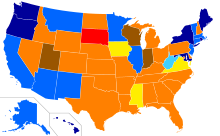
State Medicaid coverage of medically necessary abortion services. Navy blue: Medicaid covers medically necessary abortion for low-income women through legislation Royal blue: Medicaid covers medically necessary abortions for depression-income women under court order Gray: Medicaid denies ballgame coverage for low-income women, except for cases of rape, incest, or life endangerment.
Seventeen states, including New York, utilise their ain funds to encompass all or most "medically necessary" abortions sought past depression-income women nether Medicaid, 13 of which are required past land court orders to exercise and then.[56]
Women's ballgame experiences [edit]
In the 1920s, women in the New York City metro expanse would sometimes endeavour to induce abortions using botulism. In some cases, doctors who suspected an illegal abortion had occurred for which the women were seeking medical handling at home would turn down to attend these women.[32] One adult female who did this was Mary Parker of Brooklyn, dying of her illegal abortion in 1929 and leaving behind three children. Her official cause of death was listed equally gangrene, not botulism poisoning.[32]
Effectually 1947, a immature nurse and her young man with some medical training borrowed an apartment in New York City from friends. While the friends were gone, the boyfriend performed an illegal abortion on his girlfriend, leaving blood all over the floor and kitchen table.[32]
During the 1940s and 1950s, nurses sometimes had to attend to women admitted to Bellevue Hospital because of botched illegal abortions. These dying women's final hours were frequently filled with talking to the police force about the procedure equally part of interview designed to eventually prosecute people performing illegal abortions. A few were and so terrified that they did not tell the police force the name of the person before they died.[32]
In the 1960s, a woman named Bricklayer attending Ohio State went to a Planned Parenthood clinic to seek information on getting an abortion. At the time, the Ohio-based clinic but provided information on birth command and offered reproductive health care. They quietly referred her to a clinic in New York Metropolis, and Mason then chosen to make an appointment where she was told the procedure would price around Us$150. With help from her boyfriend and her best friend, as she but had US$50 in the bank, she worked covertly to get the coin for the process; she stole glass bottles from a neighbor, so she could turn them in for Us$0.05 a piece to fund her abortion. Her friend also collected glass bottles from her own female parent to get money for the abortion. Mason and her boyfriend then drove his Chevy Impala through the night to Manhattan. "I was pretty devastated past his reaction to kind of but treat it like it was my mistake, that was the message I was getting. [...] I was only trying to go along my mind on the mission, basically, that I'm doing this considering I desire to and, regardless of how he is going to behave, I'chiliad not going to pull the car over." When she finally got the ballgame, it was quick, simply painful. She attributes her ability to get an abortion to her geography, assertive if she had lived in a state like Kansas or Missouri, she would not have been able to get one.[57]
Then 18-year-old Connecticut resident Vikki Wachtel went to New York Metropolis to get an abortion at Bellevue Hospital in October 1970, where she had post-abortion complications. Her abortion took place only 5 months afterward abortion became legal in New York Land. Of her experience, she said: "The staff made the states feel like we were near to commit a crime. [...] It was MY Selection to not have a kid in 1970, and information technology must remain a adult female'due south choice to do so on a national level. [...] These overreaching and restrictive laws will simply make abortions more unsafe, not eliminate them."[58]
Christine Marinoni had an abortion in 2010. She fabricated the decision with her wife, Cynthia Nixon, subsequently the couple learned that the fetus Marinoni was carrying was not viable.[59]
Illegal ballgame injuries and deaths [edit]
In 1962, around i,200 women were admitted to hospitals in New York City's Harlem Infirmary as a result of incomplete attempted abortions.[four] In the period between 1972 and 1974, Texas and New York State had the largest number of illegal abortion deaths. Texas recorded 14 in this period, while New York had 11 in a period where 63 deaths from illegal abortions were reported nationwide. In 1972, New York had 10 illegal abortion deaths. In 1973, it had one. In 1974, the state recorded no illegal abortion deaths. The deaths in the District of Columbia and New York in this period demonstrated that even where abortion is legal, women face circumstances that drive them to have irregular, not-physician assisted abortions. There are a variety of factors for this, including lack of pedagogy, poverty, and distrust of the medical establishment.[60]

Susannah Lattin was an American woman who died of a postpartum infection at an illegal motherhood clinic at 6 Amity Identify in New York City, operated by Henry Dyer Grindle.[61] Lattin became pregnant by George C. Houghton, a clerk at Whitehouse'southward kick and shoe store on Fulton Street, Brooklyn. Houghton paid $50 to Dr. J.C. Harrison to perform an abortion, but Lattin did not become through with it. She was nonetheless hoping that Houghton would marry her. Houghton then quit his job and moved to Philadelphia to escape the situation. Lattin next went to her cousin, George H. Powell, who worked as a butcher at the Washington Market. Powell pretended to be her husband and arranged for her, as "Mrs. Smith", to see Dr. Henry D. Grindle, who ran an unauthorized "lying-in" hospital that allowed significant adult female to have their children and accept them illegally adopted. The doctor wanted her to pay $150, only she could only pay $100 and he accepted it.[13] Lattin checked into the lying-in infirmary on August 5, 1868; then, a few weeks subsequently, she delivered a healthy baby male child who was adopted anonymously, without any record kept of the adoptive parents. Around August 18, 1868, she developed a postpartum infection. The medical educatee who attended to her realized Lattin was in serious condition, and was not likely to survive, and he persuaded her to tell him her existent name, so he could notify her family unit. The bulletin got to her parents after she had died. Coroner Aaron B. Rollins investigated the expiry.[13]
Intersections with religion and religious figures [edit]
In 1990, John Central O'Connor of New York suggested that, past supporting abortion rights, Cosmic politicians who were pro-pick risked excommunication. The response of Catholic pro-choice politicians to O'Connor's comment was more often than not defiant. Congresswoman Nancy Pelosi asserted that, "There is no desire to fight with the cardinals or archbishops. But it has to exist clear that we are elected officials, and we uphold the police, and we back up public positions split up and apart from our Catholic faith."[62]
Abortion rights activities [edit]
Activities [edit]

link=File:%22Go_Mo%22_(Morris_Udall)_balloons_and_a_Keep_Abortion_Legal_sign_(with_a_Morris_Udall_sign_behind_it)_at_1976_DNC.jpg

Calls to Save Planned Parenthood at 2017 New York City Women's March
Café Altro Paradiso in New York City held a fundraiser for Planned Parenthood on May 19, 2019, to support the organization'due south abortion services.[63]
Protests [edit]
#StopTheBans was created in response to six states passing legislation in early 2019 that would almost completely outlaw abortion. Women wanted to protest this action, as other state legislatures started to consider similar bans as part of a move to try to overturn Roe 5. Wade. One protest equally function of #StopTheBans took place at Foley Square in New York City on May 21.[64]
Views [edit]
Women in Film Executive Director Kirsten Schaffer said of Georgia and other states similar restrictive abortion bans passed in early 2019: "A woman'southward right to make choices about her own trunk is fundamental to her personal and professional well-existence. [...] We support people who brand the selection non to accept their production to Georgia or take a job in Georgia because of the callous anti-choice police force. To that finish, we've compiled a list of pro-selection states that offering meaningful revenue enhancement rebates and production incentives, and encourage everyone to explore these alternatives: California, Colorado, Hawaii, Illinois, Maine, Nevada, New Jersey, New United mexican states, New York, Washington."[65]
Anti-abortion views and activities [edit]
Activism [edit]
In 1873, Anthony Comstock created the New York Society for the Suppression of Vice, an institution dedicated to supervising the morality of the public. Later that year, Comstock successfully influenced the The states Congress to laissez passer the Comstock Law, which made it illegal to deliver, through the U.S. post, whatever "obscene, lewd, or lascivious" material. It besides prohibited producing or publishing information pertaining to the procurement of abortion, or the prevention of conception or venereal disease, even to medical students.[66]
Activities [edit]
In April 1992, anti-abortion activists organized the "Spring of Life" protests in Buffalo. This was ane of three large anti-abortion protests that received extensive media coverage.[39]
Violence [edit]
There was an arson set on at an ballgame clinic in New York in 1979 that caused effectually U.s.$250,000 in damage.[39] An incident of anti-abortion violence occurred at an abortion clinic in New York City on December ten, 1985.[39] Another occurred at an abortion clinic in Syracuse, New York, on May 23, 1990.[39] Another act of violence happened at an abortion clinic in Buffalo, New York, on April 18, 1992.[39] Dr. David Gandell of Rochester, New York, sustained serious injuries on October 28, 1997, after being targeted by a sniper firing through a window in his home.[67]
Between 1993 and 2015, xi people were killed at American abortion clinics.[68] Dr. Barnett Slepian was shot to death with a high-powered rifle at his home in Amherst, New York, on October 23, 1998. His was the concluding in a serial of similar shootings against providers in Canada and northern New York land which were all likely committed by James Kopp. Kopp was bedevilled of Slepian's murder afterwards existence apprehended in France in 2001.[69] [68]
See also [edit]
- Abortion in the United States
Footnotes [edit]
References [edit]
- ^ Jones, Rachel K.; Witwer, Elizabeth; Jerman, Jenna (2019-09-11). "Ballgame Incidence and Service Availability in the United States, 2017". Guttmacher Establish. doi:ten.1363/2019.30760. PMC5487028 . Retrieved 2020-04-13 .
- ^ "When Abortion Was a Crime". www.theatlantic.com . Retrieved 2019-05-22 .
- ^ Jessica Ravitz (23 June 2016). "The surprising history of abortion in the U.S." CNN . Retrieved 2019-05-23 .
- ^ a b c d Larson, Jordan. "Timeline: The 200-Year Fight for Abortion Access". The Cut . Retrieved 2019-05-25 .
- ^ a b c d e f one thousand h Buell, Samuel (1991-01-01). "Criminal Abortion Revisited". New York University Constabulary Review. 66 (vi): 1774–1831. PMID 11652642.
- ^ "Biographical Note". The Margaret Sanger Papers. Sophia Smith Drove, Smith College, Northampton, Mass. 1995. Retrieved 2006-10-21 .
- ^ a b c d Tyler, C. Westward. (1983). "The public wellness implications of ballgame". Annual Review of Public Wellness. 4: 223–258. doi:ten.1146/annurev.pu.04.050183.001255. ISSN 0163-7525. PMID 6860439.
- ^ a b Reagan, Leslie J. (1998-09-21). When Abortion Was a Criminal offense: Women, Medicine, and Law in the United States, 1867–1973. University of California Press. ISBN9780520216570.
- ^ a b Pollitt, Katha (1997-05-01). "Abortion in American History". The Atlantic . Retrieved 2019-05-26 .
- ^ a b Alford, Suzanne M. (2003). "Is Self-Ballgame a Key Right?". Duke Constabulary Journal. 52 (5): 1011–29. JSTOR 1373127. PMID 12964572. Archived from the original on 2019-01-22. Retrieved 2019-05-22 .
- ^ "Abortion Reform in Washington State - HistoryLink.org". www.historylink.org . Retrieved 2017-10-09 .
- ^ Hoolihan, Christopher (2001). An Annotated Catalogue of the Edward C. Atwater Drove of American Popular Medicine and Health Reform. Boydell & Brewer. ISBN1580460984.
- ^ a b c "The Amity Place Mystery". The New York Times. August 30, 1868.
- ^ a b Kovach, Nib (Apr eleven, 1970). "Concluding Approval of Abortion Pecker Voted in Albany". The New York Times. Archived from the original on November 26, 2021. Retrieved November 26, 2021.
- ^ Kovach, Bill (April 12, 1970). "Rockefeller, Signing Abortion Pecker, Credits Women's Groups". The New York Times. Archived from the original on November 26, 2021. Retrieved Nov 26, 2021.
- ^ a b c ane Laws of the Country of New York Passed at the I Hundred and Ninety-Third Session of the Legislature, ch. 127, at 852 (1970), bachelor online.
- ^ "Nib to Legalize Abortions Clears Hawaii Legislature". The New York Times. February 25, 1970. Archived from the original on Nov 26, 2021. Retrieved November 26, 2021.
- ^ Willke, J.C. (September 1992). "Very few illegal ballgame deaths". American Journal of Obstetrics and Gynecology. 167 (iii): 854–v. doi:x.1016/s0002-9378(xi)91601-9. ISSN 0002-9378. PMID 1530050.
- ^ Winter, Meaghan (June 15, 2015). "Why Are Crunch Pregnancy Centers Not Illegal?". Slate . Retrieved March 15, 2018.
- ^ Stempel, Jonathan (January 5, 2018). "Court voids Baltimore law requiring 'no abortion' clinic disclaimers". Reuters . Retrieved March xx, 2018.
- ^ McEvers, Kelly (November five, 2015). "California Law Adds New Twist To Abortion, Religious Freedom Debate". All Things Considered. NPR. Retrieved March 15, 2018.
- ^ National Institute of Family and Life Advocates five. Harris , 839 F.3d 823 (9th Cir. 2016).
- ^ a b c Lai, G. M. Rebecca (2019-05-15). "Abortion Bans: eight States Have Passed Bills to Limit the Process This Year". The New York Times. ISSN 0362-4331. Retrieved 2019-05-24 .
- ^ "Abortion Laws". Findlaw . Retrieved 2019-05-23 .
- ^ "New York Dems Flex Muscles, Laissez passer Reproductive Health Act". CBSNewYork. 2019-01-22.
- ^ Russo, Amy (2019-01-23). "Andrew Cuomo Signs Abortion Bill Into Police force, Codifying Roe v. Wade". Huffington Post.
- ^ a b c "Are at that place *any* states working to protect abortion rights?". Well+Skilful. 2019-05-17. Retrieved 2019-05-25 .
- ^ Bump, Bethany (2019-01-22). "Cuomo signs Reproductive Health Deed after Legislature votes". Times Union . Retrieved 2019-05-25 .
- ^ "New York passes beak expanding abortion admission". 22 January 2019.
- ^ "Timeline of Important Reproductive Freedom Cases Decided by the Supreme Court". American Ceremonious Liberties Union . Retrieved 2019-05-25 .
- ^ Greenhouse, Linda (Feb 20, 1997). "High Court Upholds xv-Foot Buffer Zone At Abortion Clinics". The New York Times.
- ^ a b c d e Flanagan, Caitlin (2007-05-01). "The Sanguine Sex". The Atlantic . Retrieved 2019-06-02 .
- ^ a b Arndorfer, Elizabeth; Michael, Jodi; Moskowitz, Laura; Grant, Juli A.; Siebel, Liza (December 1998). A State-By-State Review of Ballgame and Reproductive Rights. DIANE Publishing. ISBN9780788174810.
- ^ a b c "Abortion Incidence and Services in the United States, 1995-1996". Guttmacher Institute. 2005-06-fifteen. Retrieved 2019-06-02 .
- ^ Jones RK, Kooistra K (March 2011). "Abortion Incidence and Admission to Services In the United States, 2008" (PDF). Perspectives on Sexual and Reproductive Wellness. 43 (ane): 41–50. doi:10.1363/4304111. PMID 21388504.
- ^ Gould, Rebecca Harrington, Skye. "The number of abortion clinics in the U.s. has plunged in the last decade — here'south how many are in each state". Business concern Insider . Retrieved 2019-05-23 .
- ^ businessinsider (2018-08-04). "This is what could happen if Roe v. Wade fell". Business organization Insider (in Castilian). Archived from the original on 2019-05-24. Retrieved 2019-05-24 .
- ^ "Here's Where Women Have Less Access to Planned Parenthood". Retrieved 2019-05-23 .
- ^ a b c d e f Jacobson, Mireille; Royer, Heather (Dec 2010). "Aftershocks: The Touch on of Clinic Violence on Abortion Services". American Economic Journal: Applied Economics. 3: 189–223. doi:x.1257/app.three.1.189.
- ^ "Abortion Surveillance --- United states of america, 2000". world wide web.cdc.gov . Retrieved 2019-05-25 .
- ^ "Abortion Surveillance --- United states of america, 2001". world wide web.cdc.gov . Retrieved 2019-05-25 .
- ^ "Abortion Surveillance --- Us, 2003". world wide web.cdc.gov . Retrieved 2019-05-25 .
- ^ "Guttmacher Information Center". data.guttmacher.org . Retrieved 2019-05-24 .
- ^ Jones, Rachel Thou.; Witwer, Elizabeth; Jerman, Jenna (2019-09-xi). "Abortion Incidence and Service Availability in the United states of america, 2017". Guttmacher Found. doi:x.1363/2019.30760. PMC5487028 . Retrieved 2020-04-13 .
- ^ Jatlaoui, Tara C. (2019). "Abortion Surveillance — United states, 2016". MMWR. Surveillance Summaries. 68 (xi): 1–41. doi:x.15585/mmwr.ss6811a1. ISSN 1546-0738. PMID 31774741.
- ^ Jatlaoui, Tara C. (2017). "Abortion Surveillance — U.s.a., 2014". MMWR. Surveillance Summaries. 66 (24): 1–48. doi:ten.15585/mmwr.ss6624a1. ISSN 1546-0738. PMC6289084. PMID 29166366.
- ^ Jatlaoui, Tara C. (2017). "Abortion Surveillance — United states, 2014". MMWR. Surveillance Summaries. 66 (24): 1–48. doi:10.15585/mmwr.ss6624a1. ISSN 1546-0738. PMC6289084. PMID 29166366.
- ^ "NYC Induced Ballgame Summary by Woman's Race/Ethnicity". Retrieved 2016-ten-10 . , NYC Dept of Wellness and Mental Hygiene, Office of Vital Statistics, New York Country, 2012
- ^ "No. of abortions among women aged 15–19, by land of residence, 2013 by racial grouping". Guttmacher Data Center . Retrieved 2019-05-24 .
- ^ a b c "Abortion Surveillance -- United States, 1992". world wide web.cdc.gov . Retrieved 2020-05-06 .
- ^ a b c "Abortion Surveillance -- United states, 1995". www.cdc.gov . Retrieved 2020-05-06 .
- ^ a b c "Abortion Surveillance -- United States, 1996". www.cdc.gov . Retrieved 2020-05-06 .
- ^ a b c Jatlaoui, Tara C. (2017). "Abortion Surveillance — Usa, 2014". MMWR. Surveillance Summaries. 66 (24): ane–48. doi:ten.15585/mmwr.ss6624a1. ISSN 1546-0738. PMC6289084. PMID 29166366.
- ^ a b c Jatlaoui, Tara C. (2018). "Abortion Surveillance — United States, 2015". MMWR. Surveillance Summaries. 67 (13): i–45. doi:10.15585/mmwr.ss6713a1. ISSN 1546-0738. PMC6289084. PMID 30462632.
- ^ a b c Jatlaoui, Tara C. (2019). "Ballgame Surveillance — U.s., 2016". MMWR. Surveillance Summaries. 68 (11): 1–41. doi:10.15585/mmwr.ss6811a1. ISSN 1546-0738. PMID 31774741.
- ^ Francis Roberta West. "Frequently Asked Questions". Equal Rights Subpoena. Alice Paul Plant. Archived from the original on 2009-04-17. Retrieved 2009-09-13 .
- ^ INSIDER, Nicole Einbinder. "Before Roe v. Wade, drastic women used glaze hangers, Coke bottles, Clorox, and sticks in attempted abortions". Business Insider . Retrieved 2019-05-27 .
- ^ "Would overturning abortion rights turn back clock to 1973?". The Public'south Radio. 2019-05-26. Retrieved 2019-05-26 .
- ^ "Celebrities answer phone call to share abortion testimonials". Alaska Highway News . Retrieved 2019-05-26 .
- ^ Cates, Willard; Rochat, Roger (March 1976). "Illegal Abortions in the United States: 1972-1974". Family unit Planning Perspectives. 8 (2): 86–92. doi:10.2307/2133995. JSTOR 2133995. PMID 1269687.
- ^ "A Mysterious Case. A Missing Girl Found Dead In a Private Lying-In Hospital. The Case in the Hands of the Coroner.". New York Times. August 29, 1868.
- ^ Marcovitz, Hal (1 February 2009). Nancy Pelosi: Politician. Infobase Publishing. p. forty. ISBN978-1-60413-075-1 . Retrieved 17 January 2012.
- ^ Arnold, Amanda (2019-05-17). "Buy Pastries, Support Ballgame Rights". The Cutting . Retrieved 2019-05-25 .
- ^ Arnold, Amanda (2019-05-21). "How to Join the Nationwide Abortion-Ban Protestation Today". The Cutting . Retrieved 2019-05-25 .
- ^ Low, Matt Donnelly,Cistron Maddaus,Elaine; Donnelly, Matt; Maddaus, Gene; Depression, Elaine (2019-05-28). "Netflix the Only Hollywood Studio to Speak Out in Attack Against Ballgame Rights (Sectional)". Diverseness . Retrieved 2019-06-02 .
- ^ https://archive.org/stream/anthonycomstockh00bennuoft#page/1017/mode/1up Anthony Comstock: His Career of Cruelty and Crime A Chapter from "Champions of the Church". DeRobigne Mortimer Bennett. 1878.
- ^ David S. Cohe & Krysten Connon (2015). Living in the Crosshairs: The Untold Stories of Anti-Ballgame Terrorism. Oxford Academy Printing. p. 80.
- ^ a b Stack, Liam (2015-11-29). "A Brief History of Deadly Attacks on Abortion Providers". The New York Times. ISSN 0362-4331. Retrieved 2019-05-23 .
- ^ Staba, David (2007-01-13). "Doctor's Killer Tries to Make Abortion the Issue". The New York Times. ISSN 0362-4331. Retrieved 2019-05-22 .
Source: https://en.wikipedia.org/wiki/Abortion_in_New_York
Belum ada Komentar untuk "How Many Weeks Can You Abort a Baby in New York"
Posting Komentar